“Downfallen aristocrat”
Even If This Love Disappears From the World Tonight“Downfallen aristocrat” is Izumi Wataya’s affectionate, recurring nickname for Tooru Kamiya. It begins as a teasing description of his unexpectedly refined domestic habits, then follows him into later encounters as a shorthand for the contrast between his youth and his composed, old-fashioned manner. Its repetition makes the phrase more than a one-off joke: it becomes a small piece of shared social language among Tooru, Wataya, and Maori Hino.
Origin in Tooru’s Home
During a visit to Tooru’s home, he serves tea from a pot covered by a fluffy, cotton-stuffed cozy he made himself; he explains that his sister taught him to sew. Wataya and Hino stare, prompting Tooru to ask what is wrong. Wataya answers that she had not noticed before, but he seems like a downfallen aristocrat: oddly refined. The image grows out of the scene’s specific details, not wealth or status. Tooru is in an old, plain two-bedroom apartment, and the visitors have little to look at beyond the living room and his room. The elegant impression is therefore comic precisely because it sits beside such unassuming surroundings.
Tooru resists the label immediately. He objects to being called downfallen and tells Hino not to write it down. The protest gives the nickname its teasing force: Wataya has found a description that catches something recognizable about him, while Tooru would rather not have it preserved as a defining trait. The encounter also establishes the three friends’ distinct roles in the joke. Wataya supplies the phrase, Tooru protests, and Hino observes and records moments with her camera.
A Comic Portrait of Refinement
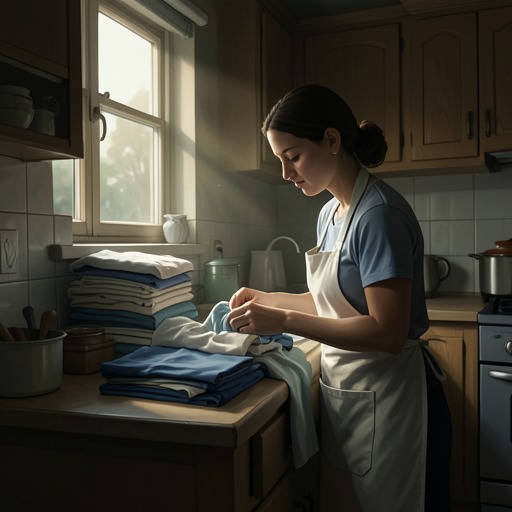
The household visit supplies further evidence for Wataya’s impression. At the two friends’ request, Tooru irons handkerchiefs and shirts after putting away the laundry; Wataya finds his skill intimidating, while Hino films him. Later, as he walks them to the station near sunset, Tooru carries a reusable shopping bag he received as a free gift. Wataya says it suits the downfallen aristocrat perfectly and wonders aloud whether he is really a high-school student. The joke now joins several small acts—sewing a tea cozy, ironing carefully, and carrying a practical shopping bag—into a portrait of someone whose ordinary routines appear unusually polished.
Hino takes a photograph of Wataya trying to suppress a smile after the remark. Tooru describes the day as unreal. That reaction does not turn the nickname into a serious accusation or a literal account of his circumstances; the humor depends on its fanciful grandness, set against mundane domestic tasks and an ordinary trip to the station. Wataya’s later repetition of the phrase in the living room, when Hino simply calls him a downfallen aristocrat and he again tells her to forget it, shows how quickly the label becomes an inside joke. Hino answers that it simply fits him so well.
The Nickname Among Friends
The phrase persists beyond the visit. When Tooru and Hino discuss possible outings, he hesitates over going somewhere as a couple because being alone together in a room would make him shy. Hino teases him by asking whether the downfallen aristocrat is shy, then moves on to suggest a library date or studying together for a test. Here the nickname is no longer attached to sewing or ironing. It has become a playful way for Hino to puncture Tooru’s restrained, formal-seeming image when he reveals embarrassment.
It also appears in a more animated exchange with Wataya. After she insists that Tooru take the bicycle pedals, she calls happily as they race down the road. Hino, recovered enough to complain theatrically, protests that the pair are cheating on her and should get away from the bicycle. Wataya calls back that she is keeping the downfallen aristocrat and that no one can stop a pair of fleeing lovers. Tooru laughs; above them, the sky is crimson. The old label now works as a mock-romantic title for him, carrying the earlier joke into the friends’ lively performance of jealousy and pursuit.
Meaning and Use
“Downfallen aristocrat” gains its meaning through repetition and contrast. Wataya first attaches it to Tooru’s practiced domestic competence; Hino then reuses it to tease him about shyness, and Wataya brings it back as part of a joking declaration that she is keeping him. Across these situations, the phrase stays affectionate rather than solemn. It makes Tooru’s refinement visible to his friends while letting them turn it into a shared joke, and his repeated objections help sustain the joke instead of ending it.
The nickname is also deliberately oversized for the things that prompt it. A homemade tea cozy, neatly ironed clothes, and a free reusable bag are ordinary objects and tasks, yet the phrase frames them as evidence of aristocratic polish. That mismatch gives the expression its comic edge. At the same time, its changing use—from an observation at home to a tease about romantic shyness and then a mock declaration on a bicycle ride—shows how a label can gather new associations without losing its original point: Tooru’s friends find his unexpected refinement both distinctive and endearing.